Project Overview
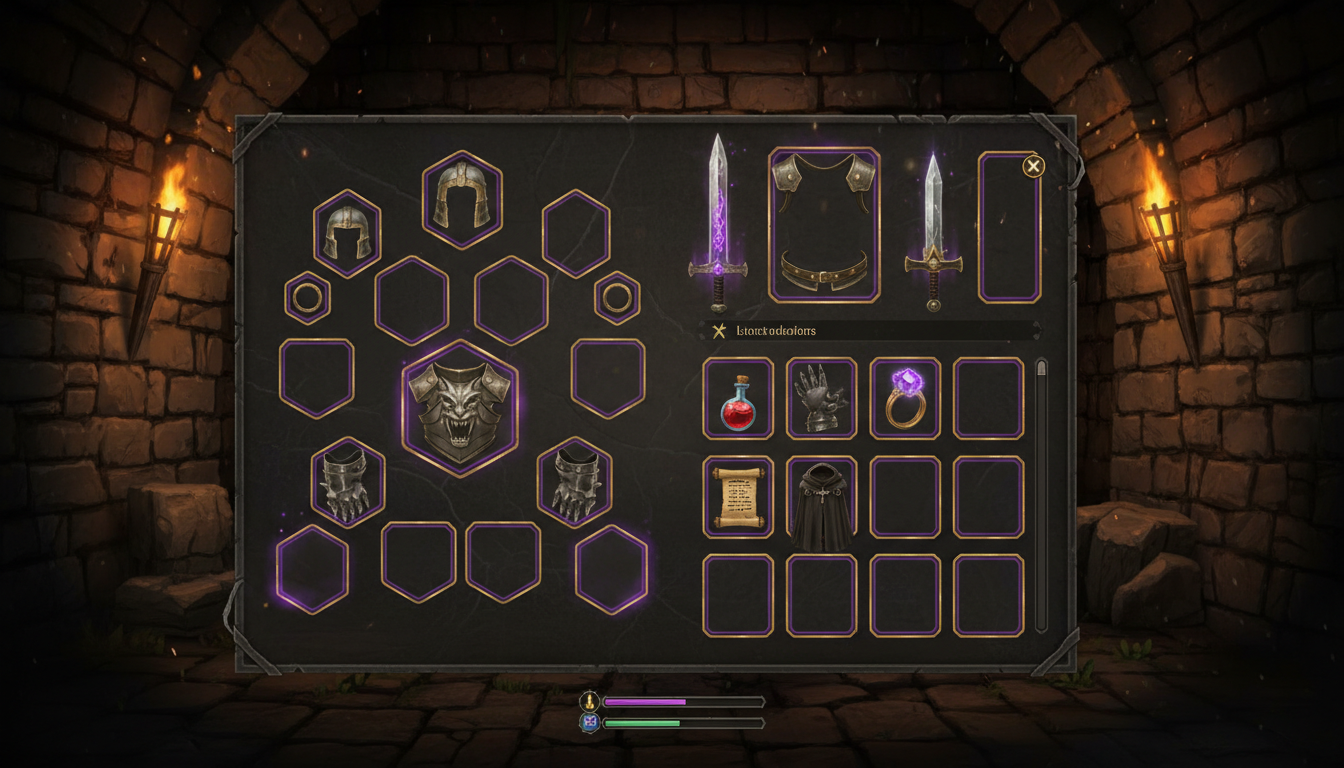
Hollowforge is a dungeon combat game featuring equipment collection, item upgrading, preparation and progression systems. It was built primarily as a school project and a personal test of Wayne's own abilities, rather than a commercial production.
Project Scope & Goals
The project aims to create a reusable gameplay framework that allows players to obtain equipment, improve their loadout and prepare before entering dungeon combat.
Wayne's Role
Gameplay and Systems Programmer. Wayne designed and developed the core inventory, equipment and progression systems as a solo project.
Responsibilities & Contributions
- Developed the inventory system
- Developed the equipment system
- Created two weapon slots
- Created four armour slots
- Created six artefact slots
- Implemented item-combination mechanics
- Implemented star-based equipment upgrades
- Created equipment validation logic
- Developed shop systems
- Developed dungeon-preparation systems
- Used ScriptableObjects to organise equipment data
- Used reusable C# classes to support additional content
- Tested and debugged the playable build
Game Mechanics & Systems
Players collect equipment across weapon, armour and artefact categories. Items can be combined or upgraded using a star-based system. The inventory, equipment slots and shop all validate item types before allowing interactions.
Development Process
The systems were separated into reusable components so that equipment data, item instances, inventory storage and loadout behaviour could be managed more clearly. ScriptableObjects define equipment templates, while runtime instances track individual item state.
Technical Challenges
- Equipping items into the correct slot
- Removing equipped items from inventory
- Detecting empty weapon, armour and artefact slots
- Combining duplicate equipment correctly
- Keeping equipment statistics and upgrade levels consistent
Solutions Implemented
- Added equipment-type and slot validation
- Separated equipment data from equipment instances
- Used reusable systems and ScriptableObjects
- Tested individual inventory and equipment interactions
- Debugged incorrect slot and item-removal behaviour
Outcome & Results
The build contains functional inventory, equipment, item-combination, shop and preparation systems.
Lessons Learned
- Designing reusable game architecture
- Managing data between connected gameplay systems
- Testing edge cases
- Debugging complex system interactions
- Planning systems for future expansion
Screenshots
Screenshot 1
Screenshot 2
Screenshot 3

